
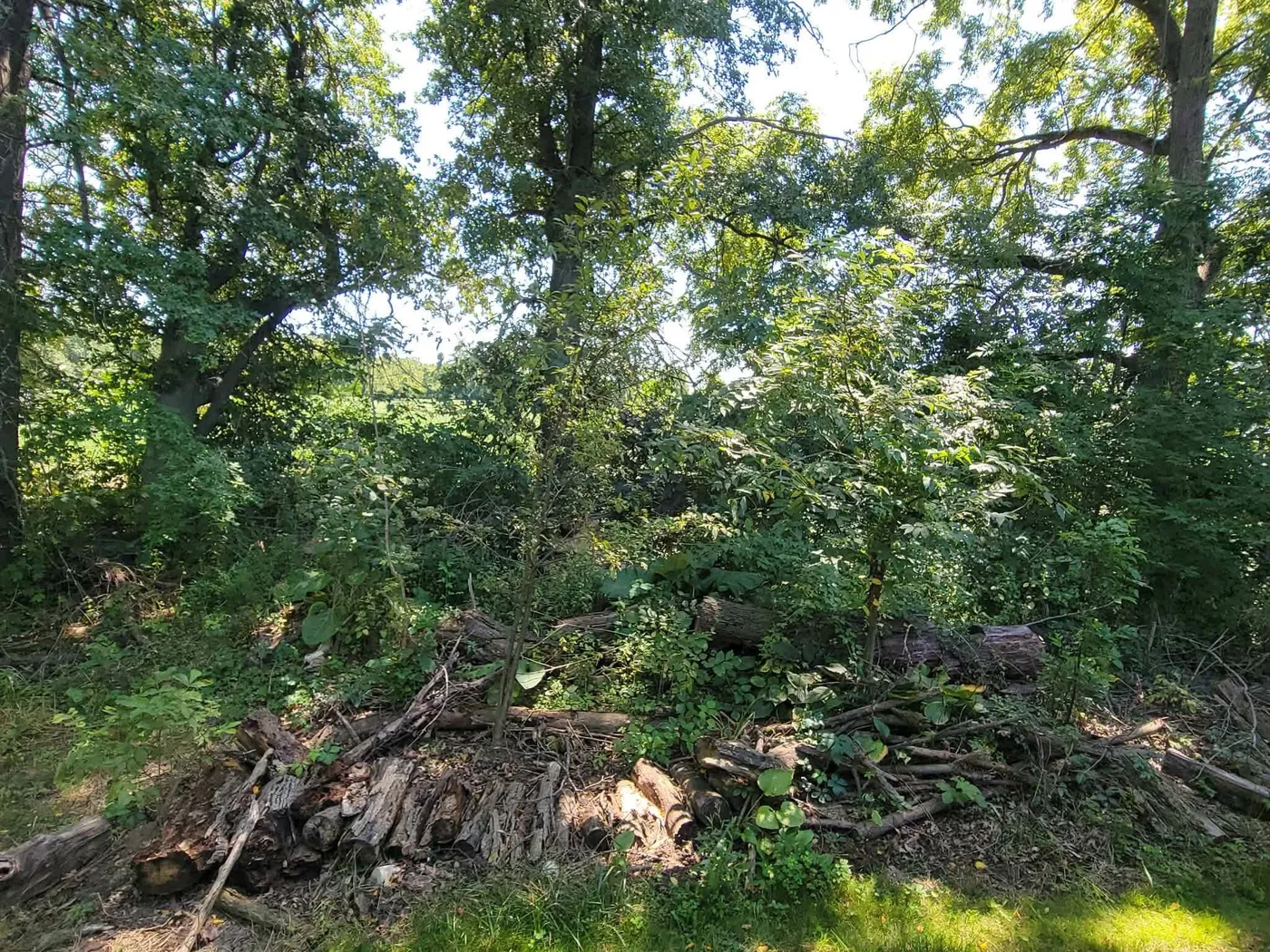
Should you sell the timber before you clear land in Ohio?
Sell first only when the woods hold sawlog-size trees of species mills want. Walnut and white oak lead, then red oak, maple and cherry. Those trees can sell standing, while brush, saplings, small stems and dead ash bring little or nothing. Get a forester’s eyes on the woods, sell the good trees under a written contract, then clear.
The order matters because the two jobs want different trees. A mill pays for size and quality in the right species. Our tracked mulcher works on the growth below that. Land clearing on wooded acreage usually starts after the sale, with the brush, saplings and small stems nobody bought.
What are Ohio timber prices right now?
The newest numbers come from the July 2026 Ohio Timber Price Report. For spring 2026, the statewide stumpage mean for walnut was $1,958 per thousand board feet, Doyle scale. White oak averaged $940. Red oak averaged $467, hard maple $468, and the catch-all line for other species $160.
Stumpage is the price for trees sold as they stand. The buyer cuts them and hauls them away. OSU Extension says most private woodland owners sell their timber this way.
The Ohio State University began producing the report in 2003, in cooperation with the Ohio Division of Forestry. It comes out twice a year, in January and July. It lists prices for sawlogs delivered to the mill and for stumpage, from a survey of Ohio forest products companies.
The newest prices come from a March to May 2026 survey. All the figures below are statewide stumpage, in dollars per thousand board feet, Doyle scale.
| Species | Statewide mean, spring 2026 | Range reported, spring 2026 |
|---|---|---|
| Walnut | $1,958 | $1,500 to $3,000 |
| White oak | $940 | $700 to $1,200 |
| Hard maple | $468 | $400 to $600 |
| Red oak | $467 | $300 to $750 |
| Cherry | $353 | $230 to $500 |
| Soft maple | $340 | $275 to $450 |
| Yellow poplar | $305 | $200 to $450 |
| Hickory | $250 | $150 to $400 |
| Ash | $236 | $100 to $400 |
| Other species | $160 | $100 to $300 |
These are statewide survey averages of what mills reported paying. They are not a price for your trees, and a single tract can land far from them. The ash line rests on only 5 reports, so read it loosely.
Prices move, too. Every species in the table averaged less in spring 2026 than in the fall 2025 survey. Walnut fell from $2,522 to $1,958, and white oak fell from $1,289 to $940.
Why can one woodlot sell for far more than another?
Stumpage has no going price. OSU Extension says the price is whatever the buyer and seller agree to. Species matters, along with the number, size and quality of the trees. So do mill distance, how easy the logging is, market conditions and how badly a buyer needs logs.
That is why OSU warns sellers not to be too anxious to take the first offer. It says some owners get only a fraction of their timber’s value because they do not market it properly.
Land you plan to clear is its own case in OSU’s advice. Choosing which trees to leave for a healthy future woods matters less when the ground is changing use. The money question stays. OSU says timber on land headed for another use often has considerable value and should be marketed.
Overgrown ground is a different story. Brush, briars, saplings and small stems are worth little or nothing to a mill. Low-value species sit at the bottom of the table. On most overgrown acreage, that growth is clearing work you pay for.
Which trees are worth selling before you clear?
Sawlog-size walnut and white oak come first, then red oak, maple and cherry. Those deserve a forester’s look before any clearing starts. Pole-size trees, saplings, brush and dead ash rarely pay. Trees you plan to keep are not for sale, so flag them before a buyer or a machine arrives.
| What is standing | What a mill pays for it | What to do first |
|---|---|---|
| Mature walnut or white oak | The top of the report, with statewide means of $1,958 and $940 | Have a forester look, then sell by written sealed bid |
| Sawlog-size red oak, maple, cherry, poplar or hickory | Statewide means of $250 to $468 | Have the forester tally them with the best trees |
| Pole-size trees | Little as sawlogs yet | Ask the forester which ones, if any, to keep |
| Brush and saplings | Nothing as sawlogs | Leave them for the clearing |
| Dead ash | The ash line averaged $236, from only 5 reports | Ask the forester whether any is still sound |
| Low-value species | The other species line averaged $160 | Ask whether a buyer wants them in the sale |
| Keeper shade trees | Not for sale | Flag them before anyone cuts |
Walnut and white oak need the most care. OSU says harvesting high-value walnut or white oak with veneer-quality logs should always be left to the buyer. Poor cutting, handling or hauling can destroy much of a log’s value.
Foresters mark the trees in a sale so buyers can find them. OSU describes a paint mark at about chest height and another at ground level, on the stump. When a small area is cut, the trees around its boundary can be marked instead.
Keeper trees get the opposite mark. We flag them at the estimate and work around them. If the big oak by the future house matters to you, say so before any buyer comes to look.
How do you sell timber in Ohio?
Start with a forester. ODNR Division of Forestry foresters help landowners pick trees to harvest at no cost. Consulting foresters usually charge a percentage of the sale’s gross receipts. Then sell by written sealed bid, which OSU says usually produces the best results for private woodland owners.
When you sell timber in Ohio, ODNR says the first step is to Call Before You Cut. The Division of Forestry runs that program with OSU Extension. It connects landowners with state service foresters or private consulting foresters. The state service foresters serve all 88 counties.
Pick a forester who works for you. ODNR notes that a forester employed by a sawmill buys logs for that mill. Your own forester works on your behalf to protect your interests with timber buyers and loggers.
In a sealed bid sale, buyers usually get 4 to 6 weeks to inspect the timber and bid. The bids are opened at a set time and place. A forester can advertise the sale to multiple buyers.
The payoff shows up in the studies OSU cites. Woodland owners who sell with a professional forester receive more money for their timber.
What should the timber contract say if you plan to clear?
OSU Extension says timber sale contracts should always be written. When clearing comes next, the contract shapes that job too. It should say who owns the tops and where the logs get stacked. It should also set a deadline for the cutting and the cleanup the buyer owes.
Most timber buyers bring their own contract. OSU’s fact sheet F-38 says to treat it as a starting point. It also suggests bringing in a professional forester while you negotiate.
The tops are the big item for clearing. F-38 says ownership of byproducts, such as tree tops, should be clearly specified. If the tops stay on the ground, you want to know that before the clearing gets priced.
The log yard matters too. F-38 lists its location, and its repair when the harvest is complete, as contract points. The same list covers cleanup of logging debris and removing debris from roads, streams and trails.
Protect the trees you are keeping. F-38 covers the buyer’s financial responsibility for excessive damage to trees meant to remain. A firm cutting deadline helps as well, because it tells you when clearing can start.
What happens to the tops, limbs and small trees afterward?
Our crew clears the brush and small trees a logger leaves behind, but we do not log, fell big timber or buy timber. The tracked mulcher grinds brush and small trees where they stand, stems up to about 6 inches. Stems of 6 to 10 inches are slower, so we take them selectively. Leftover tops and limbs are sorted out at the estimate.
Some tops and limbs can be ground where they lie. Big wood is not mulcher work, which is one more reason to settle the tops in the timber contract. The post on what size trees a forestry mulcher can handle goes deeper on stem size.
That is how forestry mulching works: the machine grinds standing growth into a layer of chips right where it grew. Nothing is burned, piled or hauled off the property. Topsoil and roots stay in place, so the ground is stable the day we leave. Stumps of the stems we mulch end up 1 to 2 inches below grade, low enough to mow over.
For a homesite, our lot clearing opens up the footprint and the working room. Digging stumps out for a foundation is excavator work, which we do not do. The guide to clearing a wooded lot for a house lays out that order of work.
Timing ties the two jobs together. OSU notes a sale notice can limit logging when the area is excessively wet. Wet spring clay is the one season our crew sometimes steers around too, because it ruts.
Late summer through winter is prime clearing season, and frozen or dry ground carries the machine cleanly. Tree cutting also has a bat roost window, covered in the best time of year to clear.
What does clearing cost after the timber is sold?
Regional market rates for typical residential mulching jobs land in the low thousands per acre. Light brush costs far less than dense regrowth. A timber check and a clearing bill are separate numbers, and one does not predict the other. Our price and timeline come in writing after an on-site look.
Density drives the time. The machine clears roughly half an acre to two acres a day, depending on how thick the growth is. Most residential jobs run one to three days. Our guide to land clearing cost per acre in Ohio breaks down what moves the number.
The estimate is free, and the written price holds unless the scope changes. A timber sale changes the scope, so tell us if one is coming. We build the price around what the logger leaves.
Once the timber question is settled, the rest is land clearing after a timber sale. The brush, saplings and small trees get ground into chips where they stand. Call or text (614) 359-8762, or ask for a free estimate. We are a four-man, family-run crew based in Mansfield, working 75 miles out across north central Ohio.